
Last updated: October 2026
Quick answer
A concrete driveway that lasts in the Portland area starts below the surface: excavation, a compacted rock base, forms, rebar or wire mesh, correctly spaced control joints, and a broom finish that gives tires traction when it rains. Happy Valley Concrete pours new driveways and full replacements for homeowners in Happy Valley, Clackamas County and the Portland metro area. Estimates are free and on-site. Call (503) 782-6069.
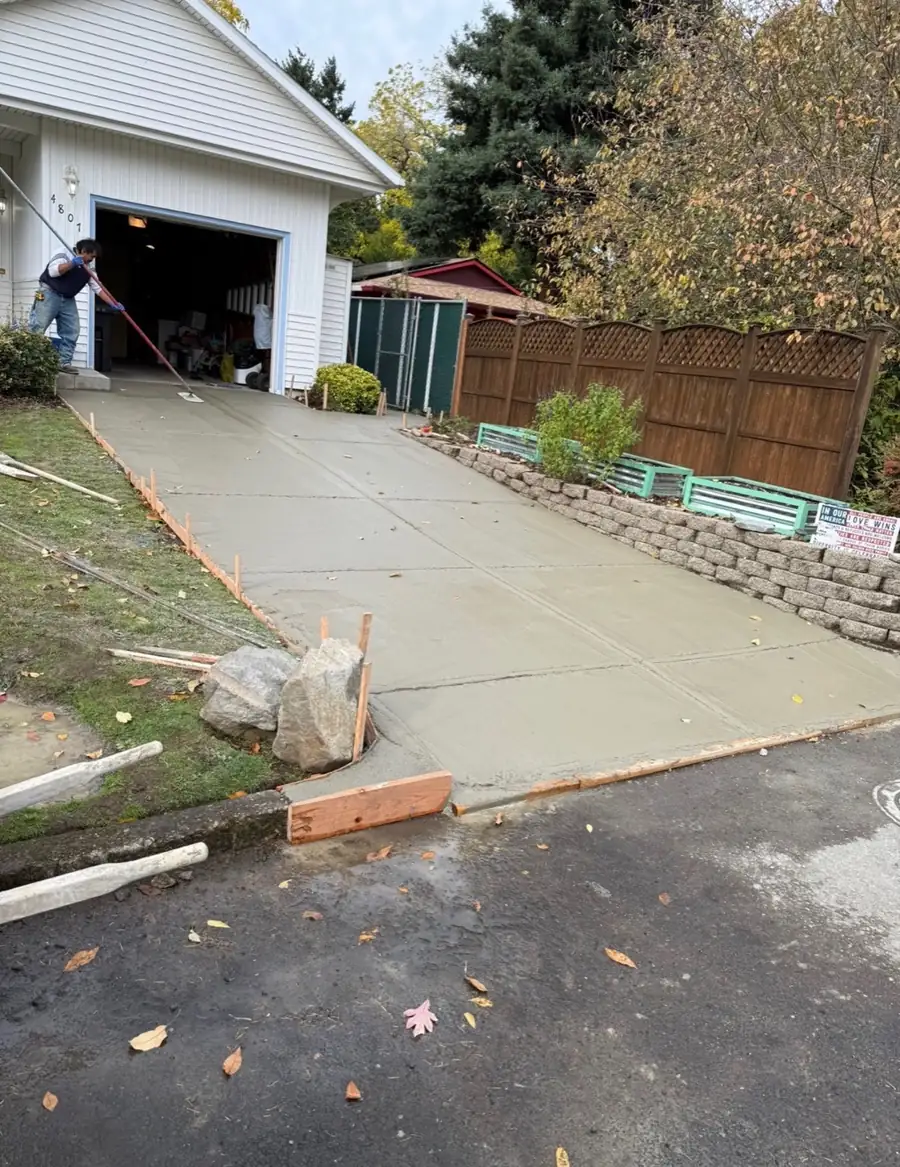
What a concrete driveway installation includes
A driveway is a structural slab, not a big sidewalk. It carries a parked car every day, the occasional delivery truck or moving van, and the weight of a wet Pacific Northwest winter soaking into the soil below it. Every driveway we quote is built the same way: excavate, compact a rock base, set forms, place rebar or wire mesh, pour, finish, and cut control joints. Skipping any of those steps is how a driveway ends up cracked or settled within a few winters.
The first visit is a free on-site estimate. We look at the grade, where the water from your roof and yard goes, how the driveway meets the garage slab and the street, and whether there is an old driveway that has to be removed. Photos and approximate dimensions help if you want a number to think about before we come out.
New driveways, replacements and resurfacing
New driveway installation
This is a full pour for new construction, or converting a gravel or worn drive to concrete. The base is graded so water moves away from the garage and house, and the driveway is formed to the width and shape you choose, including curves and flared aprons.
Driveway replacement
When concrete has cracked, settled or heaved, patching the surface rarely fixes the reason it failed. Replacement means demolishing and hauling out the old slab, correcting the base, and pouring new concrete with reinforcement and a joint plan. We will tell you honestly when a full replacement is the better value than a patch and when only a section needs to be redone.
Resurfacing
If the slab underneath is still structurally sound and the problem is a worn or stained surface, resurfacing can bring an older driveway back to life. It is not a fix for a slab that is settling or badly cracked, and we will say so during the estimate.
Base, thickness, reinforcement and joints
These four choices decide how long a driveway lasts. The base is compacted crushed rock that drains and keeps the slab from moving. Thickness should match the load: a standard residential driveway is commonly poured around four inches, with more where heavy vehicles, RVs or delivery trucks will drive. Reinforcement (rebar or wire mesh) helps hold cracks tight if they form. Control joints are cuts that tell the concrete where to crack so it happens in a straight, unnoticeable line instead of a random one.
Concrete will always shrink slightly as it cures, so a hairline crack does not mean the work was done badly. What you want is a driveway where those cracks stay tight, the panels stay level with each other, and water drains off instead of pooling. Our concrete process and permits guide walks through each step in order.
Finishes: broom, exposed aggregate, stamped and colored
The standard finish is a broom finish, a light texture that gives tires and shoes traction when the surface is wet, which matters in our climate. Exposed aggregate washes away the top film of cement to show the stones inside, a textured look that hides small stains well. Stamped and colored finishes add pattern and integral or acid-stain color, often used on a driveway apron or a decorative border. See our stamped and decorative concrete page, and read stamped concrete vs pavers if you are still deciding between the two.
Built for wet Oregon winters
Rain, soft soil and the occasional hard freeze are what test a driveway around here. Drainage away from the slab, a solid base and sealing decisions matter more than the brand of concrete. We cover moss on shaded slabs, sealing, and what freeze-thaw does to concrete in our wet-climate concrete guide. If you are also weighing asphalt, our concrete vs asphalt driveway comparison is honest about the trade-offs. We install concrete, not asphalt.
Where we build driveways
We pour driveways in Happy Valley and across Clackamas County, and in Portland, Gresham, Milwaukie, Oregon City, Lake Oswego, West Linn, Tualatin and the surrounding metro area. See every place we serve on our service areas page, or start with Happy Valley, Clackamas, or Oregon City. What a driveway project typically costs nationally, and what changes that number, is in our cost guide.
Frequently Asked Questions
How thick should a concrete driveway be?
A standard residential driveway is commonly poured around four inches thick on a compacted rock base, with extra thickness where heavy vehicles, RVs or delivery trucks will drive. Your written estimate should state the thickness, base depth and reinforcement so you can compare bids fairly.
How long before I can drive on a new concrete driveway?
Foot traffic is usually fine within a day or two, while vehicles typically need about a week and heavier loads longer. Cool, damp Oregon weather can slow the cure, so we give you a specific timeline for your pour rather than a generic number.
Can you replace just part of my driveway?
Sometimes. It depends on whether the remaining concrete is structurally sound and can be matched for thickness and drainage. If the base under the whole slab has failed, replacing only a section just hides the problem, and we will tell you that during the estimate.
Do you install asphalt driveways?
No. Happy Valley Concrete installs concrete driveways, patios, walkways, stamped concrete and commercial concrete. We do not install asphalt.
Related services
Helpful guides
Ready to talk about your project? Call or text (503) 782-6069, Monday to Saturday, 7:00 AM to 8:00 PM, or use the free quote form.
Call (503) 782-6069