Last updated: October 2026
Quick answer
Commercial slabs are designed around the loads they carry: vehicles, equipment, racking, or a building above. Happy Valley Concrete pours heavy-duty slabs, foundations and pads for shops, barns, warehouses and small commercial buildings in the Portland metro area, with compacted base, reinforcement and joint layout matched to the use. Call (503) 782-6069 for a free estimate.
Commercial and shop concrete, built for the load
A commercial slab and a residential driveway are different animals. A slab under a shop, warehouse or retail space may carry forklifts, delivery trucks, shelving or a structure above it, and it usually has to stay flat enough for equipment. The base, thickness, reinforcement and joint layout all change with that load. We start every commercial estimate by asking what the slab will carry, what happens on it day to day, and what has to be done before the concrete arrives.
Barn, shop and outbuilding pads
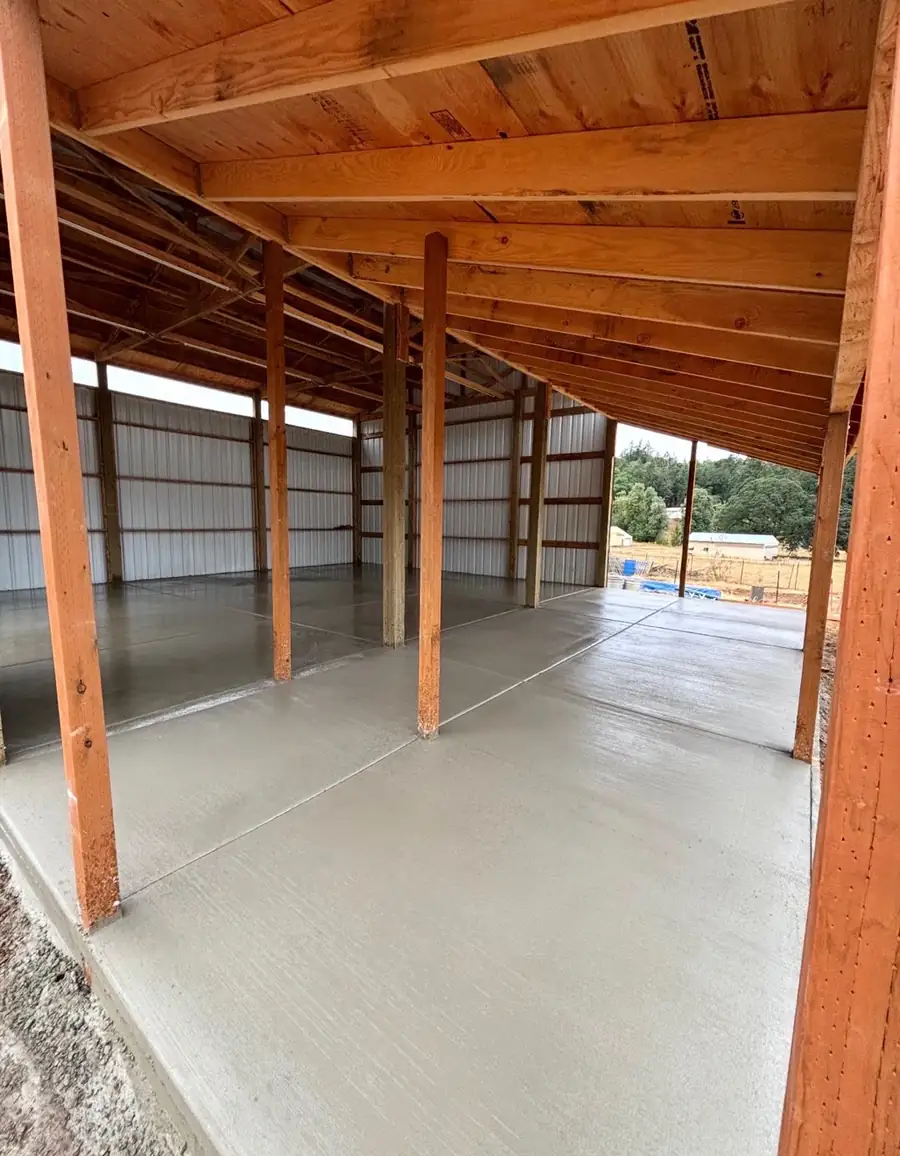
For barns, shops and outbuildings, we pour pads and slabs sized and reinforced for the use, whether it is vehicle storage, a workshop, or equipment. Larger lots in areas like Damascus, Boring and Sandy often mean bigger pads and longer access, and good site drainage is essential so the pad does not become a pond. Ask about a finish that suits your use: a smooth trowel finish for equipment, a broom finish where wet footing matters.
Foundations and commercial slabs
Foundations and slabs for commercial buildings, warehouses and retail spaces involve rebar layout, expansion and control joints, and inspections that depend on the local building department. Plans and engineering are typically provided by the owner's architect or engineer, and we build to those specifications and the applicable code. Ask us how we coordinate with your plans and inspections at the estimate.
Scheduling and minimizing downtime
A business cannot always shut down for a pour. We work around your schedule where we can, including phasing large areas, and we talk through access, deliveries, parking and cure times up front so employees and customers know what to expect. Concrete needs time to cure, and rushing traffic onto a slab is one of the most common ways to damage it.
What to send for a commercial estimate
The more you can share, the more accurate the estimate: the address, approximate dimensions, what the slab will carry, whether plans or engineering exist, existing concrete to remove, and your target schedule. Photos help. Call (503) 782-6069 or use the quote form, and choose Commercial. Our concrete process guide explains permits, inspections and what to expect.
Service area for commercial work
We take commercial projects across the Portland metro area, including Clackamas, Tualatin, Gresham and Portland, where warehouse and commercial slabs are common, plus the surrounding communities. See the service areas page, the cost guide for national ranges, and our driveway and walkway pages for residential work.
Questions to ask any commercial concrete contractor
Commercial owners and property managers get better results by asking the same questions of every bidder. What thickness and reinforcement is being priced, and who specified them? Is the subgrade being tested or proof-rolled, and what happens if soft spots are found? How are control and expansion joints laid out, and will they line up with columns and racking? What is the cure plan, and when can forklifts, trucks or customers use the slab? Who handles permits and inspections, and who pays for a re-pour if a test fails? Clear answers in writing are worth more than a low lump sum.
Flatness, finish and how the slab will be used
Finish is a functional choice on commercial floors. A hard-trowel finish is smoother and easier to sweep, but it can be slick when wet. A broom or light-texture finish improves traction in loading areas and entries, and is the usual choice outdoors. Warehouse floors that will carry narrow-aisle equipment may have flatness requirements that go beyond a normal pour, and those should be stated in the plans and priced up front, not discovered later. If a floor will later receive a coating or sealer, tell us before the pour so the finish and cure suit it.
Repairs, replacement and partial demolition
Not every commercial job is a new slab. We are also asked about cutting out and replacing a failed section, extending an existing pad, or replacing a broken loading apron. Those jobs depend on why the original concrete failed, whether it was the base, drainage, a thin section, or simple overload, and on how the new concrete will tie into the old. We look at the failure first and describe what would prevent a repeat, even when that costs more than a quick patch.
Commercial concrete slabs: what goes into the spec
When people search for commercial concrete slabs, they usually want to know what makes a commercial slab different from a residential one. The short answer is load and use. A commercial slab is designed around what will sit and move on it: racking legs, forklifts, delivery trucks, equipment or heavy foot traffic. That drives five decisions we put in writing: slab thickness, the depth and compaction of the crushed-rock base, reinforcement (rebar, mesh or fiber), concrete strength, and joint layout so cracking happens where it is planned. Around Portland and Clackamas County, wet winters and clay soils make the base and drainage especially important; a slab poured on soft, saturated ground will settle no matter how thick it is. For floors that will be coated, polished or sealed later, we also discuss finish and flatness up front so the next trade is not fighting the slab.
Frequently Asked Questions
Do you pour shop and barn slabs?
Yes. Happy Valley Concrete pours pads and slabs for barns, shops and outbuildings, sized and reinforced for how they will be used.
Do you work from architect or engineer plans?
Commercial foundations and slabs are typically built to plans provided by the owner's architect or engineer. Share them at the estimate so we can price the actual scope.
How do you minimize disruption to a working business?
We discuss scheduling, phasing, access and cure times at the estimate so the pour fits around your operations as much as possible.
How thick should a commercial concrete slab be?
It depends on loads and soil. Light commercial and shop slabs are often thicker than a typical residential slab, and forklift or truck areas thicker still, with reinforcement and a compacted rock base specified for the use.
Do you pour commercial slabs in Portland and Gresham?
Yes. We pour commercial and shop slabs across the Portland metro, including Portland, Gresham, Clackamas, Milwaukie and Happy Valley.
Related services
Helpful guides
Ready to talk about your project? Call or text (503) 782-6069, Monday to Saturday, 7:00 AM to 8:00 PM, or use the free quote form.
Call (503) 782-6069